
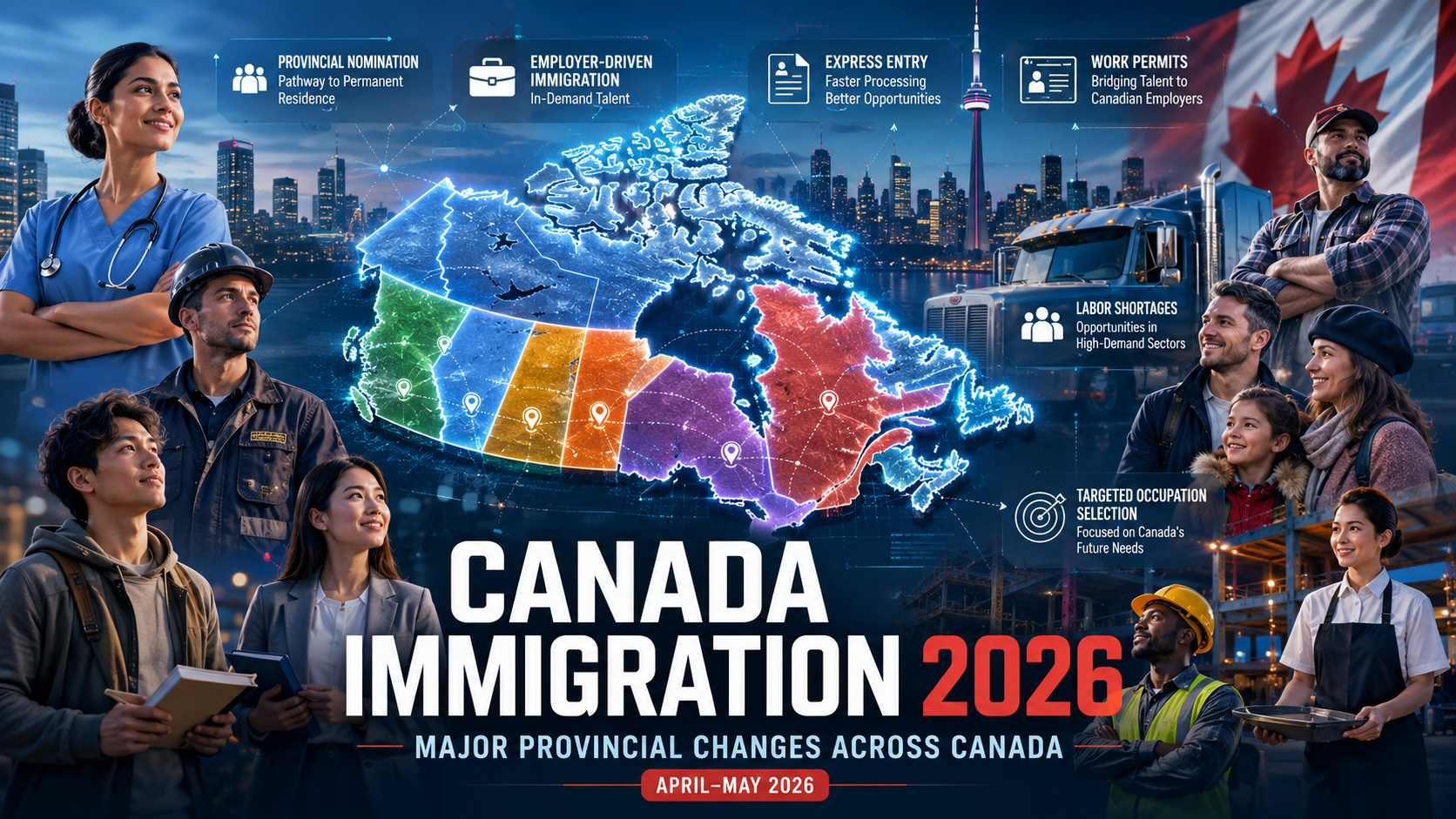
Canada Immigration: What Actually Changed Across Provinces
A clear-eyed breakdown of every major provincial and federal shift shaping Canadian immigration right now.
📅 Book a Free Consultation🔍 The Big Picture
After reviewing provincial draws, policy announcements, Express Entry activity, and federal changes from April and May 2026, one clear pattern has emerged:
Canada’s immigration system is no longer primarily a broad CRS-based competition system. It is becoming:
- Province-driven
- Employer-linked
- Occupation-targeted
- Retention-focused
- Economically selective
This is the biggest structural shift in Canadian immigration since Express Entry launched in 2015.
Biggest National Trends in 2026
Five structural shifts are reshaping who gets invited, how, and from where.
Provinces Now Dominate Selection
PNPs are the new center of economic immigration. Most 2026 Express Entry draws heavily favoured provincial nominees, French speakers, category-based occupations, and candidates already connected to Canada. The federal government is increasingly letting provinces decide which sectors receive immigration access.
Canada Prioritizes People Already Inside
Across Manitoba, Ontario, Quebec, Atlantic provinces, and new TR-to-PR initiatives, Canada increasingly prefers:
- Temporary foreign workers
- International graduates
- Existing permit holders
- Locally integrated workers
The system is shifting from “bring new immigrants” to “retain workers already contributing.”
Healthcare Is Canada’s Strongest Category
Healthcare appeared repeatedly in Alberta, Nova Scotia, Newfoundland, New Brunswick, federal category draws, and Quebec selection systems. Healthcare workers are now arguably the safest long-term PR category in Canada.
French Is Now a Massive Advantage
French creates advantages in Quebec programs, Express Entry draws, New Brunswick, Atlantic pathways, and Francophone initiatives. Federal French draws in April 2026 invited 4,000 candidates with CRS scores as low as 400–419 — one of the biggest competitive advantages available today.
Generic Overseas Profiles Are Weakening
High CRS alone is no longer enough. The strongest candidates now combine:
- Provincial nomination
- Employer support
- Canadian experience
- French ability
- Targeted occupations
Province-by-Province Breakdown
Each province is pursuing a distinct immigration strategy in 2026. Here’s what that means for your pathway.
British Columbia
Elite Economic Immigration- Targets highly paid professionals ($120K+ salary level)
- Prioritizes tech, engineering, AI/data, healthcare specialists
- Focus on “high economic impact” candidates
- BC is becoming Canada’s premier economic immigration province
Alberta
Occupation-Specific Labour- Targeted draws for healthcare, tourism, law enforcement
- Extremely low cutoffs for the right occupation
- Occupation now matters more than generic CRS score
- Best for trades, hospitality, healthcare, rural labour
Saskatchewan
Strict Sector-Cap Management- Capped sectors with quota-controlled intake
- Retail/hospitality caps filled almost immediately
- Priority: healthcare, agriculture, mining, manufacturing
- Also: skilled trades, energy, technology
Manitoba
Retention of Existing Workers- 90%+ of targeted invitations went to workers already in Manitoba
- Prioritizes strategic recruits and education occupations
- Rewards local integration and employer relationships
- Strongly favours temporary resident retention
Ontario
Regional Employer-Linked Selection- Targets GTA workers and regional labour shortages
- Invites foreign workers, international students, in-demand workers
- No longer relying on passive Express Entry intake
- Regional targeting + employer-linked selection now central
Quebec
French-Focused + Labour Balancing- PEQ reopening + large PSTQ draws
- Continues to support mid-skilled and manual occupations
- French remains absolutely essential
- Strong option for trades, international students, locals
New Brunswick
Francophone + Employer-Driven- Priority: healthcare, IT, construction, transportation
- Atlantic Immigration Program (AIP) becoming central
- Strong focus on French-speaking candidates
- Employer support + sector filtering required
Nova Scotia
Active EOI Management- Annual EOI expiry introduced — pools actively managed
- Top priority: healthcare and skilled trades
- TEER 0–4 occupations prioritized
- Moving away from passive pools to active labour inventories
Newfoundland & Labrador
Employer-Driven Atlantic Recruitment- Regular draws despite lower national allocations
- Main priorities: healthcare, employer-supported candidates
- Tied to Atlantic retention and practical labour needs
- Employer recruitment remains central to the pathway
Federal / IRCC Changes
Four major federal-level shifts are reshaping the national immigration framework.
Express Entry Going Category-Based
2026 draws increasingly favour provincial nominees, French speakers, Canadian Experience Class, and category-based occupations. Pure CRS-based draws are becoming less frequent.
Major Express Entry Reforms Under Review
IRCC officially launched consultations to simplify Express Entry, review CRS, and potentially restructure the entire system. This could become one of the largest Express Entry changes ever.
New TR-to-PR Retention Strategy
Canada confirmed plans to transition 33,000 workers already in Canada to PR across 2026–2027. This strongly confirms the national shift toward retaining existing temporary residents.
PR Processing Fees Increased
Permanent residence processing fees increased on April 30, 2026 across Express Entry, PNP, business immigration, and family sponsorship. Plan your budget accordingly.
Old Model vs. 2026 Reality
The structural shift in Canadian immigration is best understood by comparing what the system used to reward versus what it now prioritizes.
| Dimension | ❌ Old Model | ✅ New 2026 Model |
|---|---|---|
| Selection Basis | CRS competition | Province-driven targeting |
| Invitation Style | Broad invitations | Occupation-specific selection |
| Candidate Location | Overseas-focused | Retention of in-Canada workers |
| Pool Management | Passive pools | Actively managed inventories |
| Immigration Type | General economic | Sector-priority immigration |
| Volume Strategy | Large intake growth | Controlled, sustainable immigration |
Strongest Advantages in 2026
The most competitive candidates now combine one or more of the following factors.
Provincial Nomination
Canadian Work Experience
Employer Support
French-Language Ability
Healthcare / Trades Occupation
Provincial Ties
Temporary Resident Status in Canada
Regional Integration
Category-Based Eligibility
⚠️ Most Important Strategic Conclusion
The biggest mistake applicants can make in 2026 is treating Canadian immigration as “just improving your CRS score.”
The system is now heavily dependent on choosing the right strategy — which is often more important than CRS score alone.
To compete effectively in 2026, you need to:
- Choose the right province for your profile
- Select the right pathway for your occupation
- Build employer connections and support letters
- Align your application with labour shortages
- Create a province-specific immigration strategy
Not Sure Which Path Is Right for You?
Our consultants at Helping Hands Immigration will review your profile and build a custom 2026 strategy — province, pathway, and timeline included.
📅 Book a Consultation with Helping Hands Immigration
